
Introduction
Picture this. You’ve finally bought your plot in Hyderabad, the architect has handed you the drawings, and you’re sitting with your site engineer going over the material list. Everything sounds fine until he says one line: “Sir, we need to decide on sand, M Sand vs River Sand?”
And just like that, you’re stuck.
Most homeowners have never thought about sand until this exact moment. You know cement matters, steel matters, but sand? It’s just sand, right? Wrong. Ask any mason who’s worked for fifteen years, and he’ll tell you sand quality can make or break your plastering, your RCC strength, even how long your walls stay crack-free.
This confusion is more common than you’d think, and honestly, it’s not your fault. There’s a lot of mixed information floating around, some of it outdated, some of it just plain wrong. Old-timers swear by river sand because that’s what they grew up using. Younger engineers push M Sand because it’s what’s taught in colleges now and what government projects mandate.
So which one is actually right for your house in 2026?
We’ve been building homes and commercial spaces across Hyderabad long enough to have used both, tested both, and dealt with the headaches that come from picking the wrong one. In this guide, we’ll break down M Sand and River Sand honestly, no sugarcoating, no sales pitch, just what actually works and why.
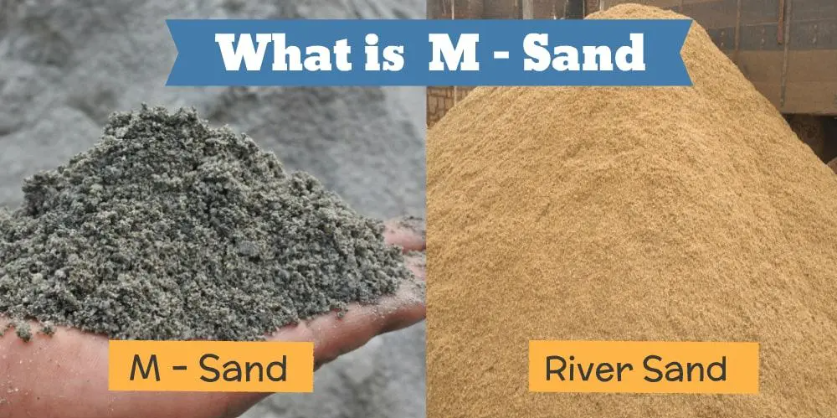
What is M Sand?
M Sand, short for Manufactured Sand, is exactly what it sounds like. It’s produced by crushing hard granite stones in a controlled factory setup until they break down into sand-sized particles. The process usually involves a Vertical Shaft Impactor (VSI) machine that crushes the rock, followed by washing and screening to remove the fine dust and get a consistent particle size.
How M Sand is Made
- Granite boulders are collected from quarries.
- They’re crushed in stages, first into aggregates, then further into sand-sized particles.
- The crushed material passes through a washing unit to remove silt and micro dust.
- It’s screened through sieves to achieve a uniform grain size, usually matching IS 383 specifications.
That last step matters a lot. Cheap, poorly processed M Sand skips proper washing and screening, which is where most of the bad reputation comes from. Good M Sand and bad M Sand look almost identical to an untrained eye, but they behave very differently in concrete.
Common Uses of M Sand
- RCC slabs, columns, and beams
- Plastering work
- Brickwork and blockwork
- Flooring and tile laying
- Road construction
Advantages of M Sand
Consistent quality. Since it’s manufactured under controlled conditions, the particle size and shape stay fairly uniform batch after batch. You’re not depending on what a riverbed happened to deposit over the years.
No environmental damage from mining. M Sand doesn’t require dredging riverbeds, so it doesn’t disturb aquatic ecosystems or lower groundwater tables the way excessive river sand mining does.
Zero silt content when processed well. Properly washed M Sand has little to no silt, which means better bonding strength in concrete and plaster.
Cost-effective in most regions today. With river sand mining restrictions tightening across Telangana and Andhra Pradesh, M Sand has actually become the more affordable and reliably available option in many areas.
Better for the environment. Since it’s a byproduct of granite crushing, it reduces dependency on riverbeds, which is a genuine sustainability win.
Common Misconceptions About M Sand
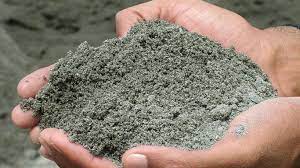
A lot of people still think M Sand is “weaker” or “not natural enough” for good construction. This mostly comes from experiences with poor-quality, unwashed M Sand sold by unreliable suppliers in the early 2010s when quality control wasn’t standardised. Today, IS-certified M Sand from a reputed supplier performs on par with, and in several strength tests, even better than average river sand.
What is River Sand?
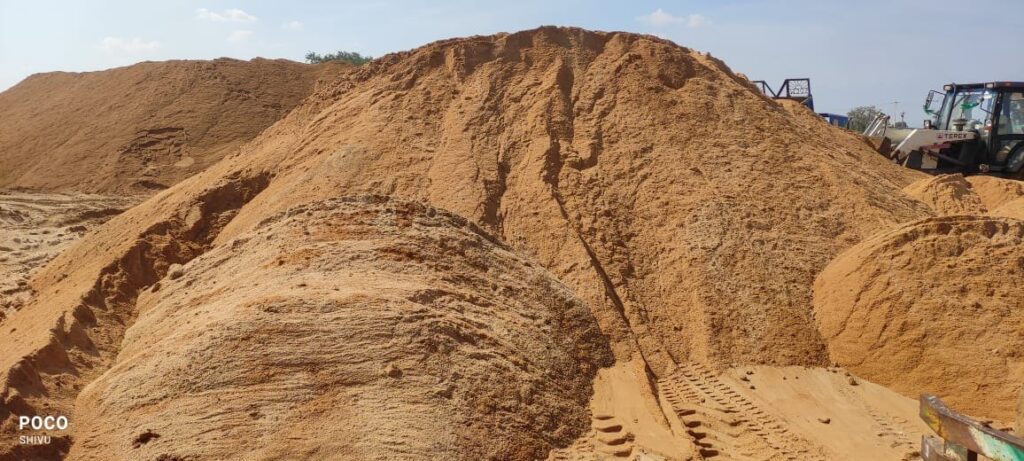
River Sand is the sand that nature has been making for thousands of years, formed by water erosion that breaks down rocks and minerals as they travel downstream. It settles in riverbeds, and traditionally, this has been the go-to material for Indian construction for generations.
Source
River sand is extracted directly from riverbeds and floodplains. In Telangana and Andhra Pradesh, it typically comes from rivers like the Krishna and Godavari basins, though mining here is heavily regulated now due to environmental concerns.
Common Uses of River Sand
- Plastering, where a smoother finish is often preferred
- Brickwork
- RCC work, though this is becoming less common due to inconsistent grading
- Flooring base preparation
Advantages of River Sand
Naturally smooth texture. The rounded grains, shaped over years by water flow, give a naturally smooth finish that many masons still prefer for plastering.
No silt washing required in most cases. Depending on the source, river sand often needs less processing before use.
Familiarity. Generations of masons have worked with it, so the workmanship comfort level is high, especially with older, experienced labour teams.
Limitations of River Sand
Environmental damage. Excessive river sand mining erodes riverbanks, disturbs aquatic habitats, and lowers groundwater levels. This is a real and documented problem, which is why several states have restricted or banned river sand mining in specific zones.
Inconsistent quality. Since it’s a natural product, particle size and cleanliness vary depending on the source, season, and depth of extraction.
Rising costs and scarcity. With mining bans and stricter regulations, legally sourced river sand has become expensive and harder to get consistently, especially around Hyderabad.
Risk of illegal sourcing. Unfortunately, some suppliers still sell illegally mined river sand, which comes with legal risk for builders and often poor quality control.
M Sand vs River Sand: Detailed Comparison
Here’s how the two stack up when you compare them side by side on the factors that actually matter for your construction.
| Parameter | M Sand | River Sand |
|---|---|---|
| Strength | High, consistent compressive strength due to angular grains that bond well | Good, but strength varies depending on source and grain quality |
| Cost | Generally more affordable and stable pricing | Higher and increasingly unpredictable due to mining restrictions |
| Availability | Widely and reliably available across Hyderabad | Limited, dependent on legal mining zones |
| Environmental Impact | Low, no riverbed disturbance | High, contributes to riverbed erosion and groundwater depletion |
| Consistency | Very consistent, factory controlled | Varies batch to batch, source dependent |
| Quality Control | Can be tested and certified to IS 383 standards | Harder to verify, especially from smaller suppliers |
| Water Absorption | Slightly higher, needs correct water-cement ratio | Lower, more predictable water absorption |
| Durability | Excellent for long-term structural use | Good, but depends on silt content and grading |
| RCC Suitability | Highly suitable when properly graded and washed | Suitable, but grading inconsistency can affect strength |
| Plastering | Good with fine-graded M Sand, needs skilled application | Traditionally preferred for a smoother hand finish |
| Brickwork | Very suitable, strong mortar bonding | Suitable, commonly used |
| Finish Quality | Slightly coarser unless finely graded | Naturally smoother finish |
| Long-Term Performance | Strong, minimal shrinkage cracks with proper mix design | Reliable, but performance drops with high silt content |
The honest takeaway from years on site is this. M Sand generally wins on strength, consistency, and sustainability. River sand still holds an edge in workability and finish for plastering, but only when it’s clean and properly sourced, which is getting harder to guarantee.
Which Sand Should You Choose in 2026?
There’s no single answer that fits every project. Here’s how we’d break it down based on what we’ve seen work across different types of builds in and around Hyderabad.
For Independent House Construction
M Sand is usually the smarter pick for RCC and structural work. It gives you predictable strength, and with Hyderabad’s granite quarries nearby, sourcing is easy and cost-effective. For the final coat of plastering, some clients still prefer a river sand and M Sand blend for a smoother look, and that’s a reasonable compromise.
For Villas
Villas often involve more detailing, exposed brickwork, and premium finishes. Here, a mix works well. M Sand for structural RCC and blockwork, and a fine-graded plastering sand (M Sand or a blend) for the finishing coats where appearance matters more.
For Apartments
Multi-storey apartment construction demands consistency across every floor. You can’t afford strength variation between the fifth floor and the fifteenth. M Sand is the practical, code-compliant choice here, and it’s what most reputed developers in Hyderabad have already shifted to.
For Commercial Buildings
Commercial structures usually involve larger spans, heavier loads, and stricter compliance requirements. M Sand’s consistency and IS-standard grading make it the safer, more scalable choice for commercial construction companies working on tighter timelines and larger volumes.
Based on the budget
If you’re working with a tight budget, M Sand is generally the more economical and stable option long term, since prices don’t swing as much as river sand, which is subject to seasonal mining restrictions.
Based on Long-Term Durability
For structural durability over 30 to 50 years, properly processed M Sand with correct grading gives more predictable, testable results. That’s not us being biased toward one material; that’s what BIS recommendations and current industry data point to.
Common Myths About M Sand
Let’s clear up a few things we hear from clients almost every week.
Myth 1: M Sand is weaker than river sand. Not true when it’s properly washed and graded. Multiple lab tests show M Sand concrete matching or exceeding river sand concrete in compressive strength.
Myth 2: M Sand causes cracks in walls. Cracks usually come from poor curing, wrong cement ratio, or bad workmanship, not from the sand itself. Blaming M Sand for cracks is like blaming the flour for a badly baked cake.
Myth 3: M Sand is not suitable for plastering. Fine-graded M Sand, sometimes called plastering sand, works perfectly well for plastering when applied by an experienced mason who understands the slight difference in workability compared to river sand.
Myth 4: All M Sand is the same quality. This one’s actually half true, and it’s the real risk. Quality varies a lot between suppliers. That’s why sourcing from a trusted, tested supplier matters more than the material type itself.
Myth 5: River sand is always more “natural” and therefore better. Natural doesn’t always mean better for engineering purposes. A material’s suitability depends on grading, cleanliness, and consistency, not just where it came from.
Myth 6: M Sand increases construction cost. In most cases in and around Hyderabad right now, it’s the opposite. With river sand mining getting restricted, M Sand tends to be the more budget-friendly and reliably priced option.
Tips Before Buying Sand
After years of sourcing sand for residential and commercial sites across Hyderabad, here’s what we tell every client before they buy in bulk.
- Always ask for the source and IS certification. Reputable suppliers will happily share this. If they hesitate, that’s a red flag.
- Check for silt content. A simple field test involves shaking a sample of sand with water in a bottle. If silt content is visibly above 3 to 4 per cent, it’s not fit for RCC work.
- Feel the grain. Good M Sand should feel gritty but not overly sharp or dusty. Overly fine, dusty sand usually means poor washing.
- Don’t just chase the lowest price. Cheap sand often means unwashed, unscreened, or illegally sourced material. It’ll cost you more in repairs later.
- Match the sand type to the work. Use RCC-grade sand for structural work and separately graded plastering sand for finishing coats. Don’t use one for both.
- Buy from a supplier your contractor has worked with before. Consistency across batches matters more than people realize, especially on larger projects.
- Test before bulk ordering. For big projects, always request a sample batch and get it lab tested before committing to a full supply order.
Why Builders Are Switching to M Sand
If you’ve spoken to civil engineers or construction companies in hyderabad recently, you’ll notice a clear shift happening across Telangana and the rest of India. A few real reasons are driving this.
Government restrictions on river sand mining have tightened significantly to protect riverbeds and groundwater tables, making legal river sand harder to source consistently.
BIS and construction codes have increasingly recognised and standardised M Sand vs river sand specifications, giving engineers confidence to specify them in structural drawings.
Granite is abundant around Hyderabad, which means local M Sand production keeps transportation costs and delays lower compared to sourcing river sand from farther basins.
Quality control technology in crushing units has improved a lot in the last five to seven years, so the “bad M Sand” reputation from a decade ago doesn’t really hold up against current manufacturing standards from good suppliers.
Put simply, the industry isn’t switching because of a trend. It’s switching because the practical, sustainable, and structural case for M Sand vs river sand has gotten stronger every year.
Why Choosing the Right Construction Company Matters
Here’s something we tell every client during their first site visit. Picking the right sand is important, but it’s honestly just one decision among hundreds that go into building a home that lasts.
The same house built with identical materials can turn out completely different depending on who’s supervising the work. Correct water-cement ratio, proper curing time, accurate steel placement, honest quantity billing, these are the things that actually decide whether your home stands strong for the next 50 years or starts showing cracks in five.
This is where the construction companies in hyderabad you choose matter more than any single material decision. A good team doesn’t just source the right sand; it tests it, documents it, and makes sure the mason on-site is actually using it the way it’s meant to be used. Execution and supervision close the gap between “good materials on paper” and “a home that actually performs well.”
At V Build Infra, the best construction companies in hyderabad, this is exactly the mindset we bring to every residential and commercial project we take on in Hyderabad. Whether it’s choosing between M Sand vs river sand, deciding on the right cement grade, or supervising the RCC pour on a hot Hyderabad afternoon, we treat every small decision as part of the bigger picture, your home’s long-term strength.
About V Build Infra
V Build Infra is a construction companies Hyderabad, working across residential construction, commercial construction, project management, construction partnering, and interior solutions.
We started with a simple idea. Homeowners deserve a house construction company in Hyderabad construction partner who explains things clearly, sources materials honestly, and doesn’t disappear once the foundation is poured.
Here’s what that looks like in practice.
Residential Construction. From independent houses to villas, we handle everything from design coordination to handover, with a focus on structural quality that’s built to last for generations, not just to pass an inspection.
Commercial Construction. We work with business owners and investors who need construction partners that understand deadlines, budgets, and compliance without cutting corners.
Project Management. For clients who already have contractors or teams in place but need an experienced eye overseeing quality, timelines, and material standards, we step in as the project management layer that keeps everything accountable.
Construction Partnering. We collaborate with landowners and investors on partnership-based development models, bringing our execution expertise to the table.
Interior Solutions. Once the structure is ready, we help bring the interiors to life with practical, quality-focused execution that matches the budget and vision of the homeowner.
Across all of this, a few things stay consistent. We use tested, quality materials, whether that’s M Sand, cement, or steel. We keep pricing transparent from the first estimate to the final bill. Our site supervision is handled by experienced engineers, not just labour contractors left to their own judgment. And we aim for on-time delivery because we know delays cost our clients real money and stress.
We’re still a growing team here in Hyderabad, and honestly, that works in our clients’favourr. You’re not just another file number in a large corporate system. You get direct access to the people actually building your home.
Conclusion
At the end of the day, the M Sand vs River Sand debate isn’t about which one is “best sand for construction” in some universal sense. It’s about which one fits your project, your budget, and your long-term goals in 2026’s construction landscape. For most residential and commercial projects in and around Hyderabad right now, M Sand offers the stronger, more consistent, and more sustainable choice, especially for RCC and structural work, while a well-sourced blend can still serve plastering needs beautifully.
But remember, the sand is just one part of the story. The real difference between a house that lasts thirty years and one that lasts a lifetime comes down to who’s supervising the work, testing the materials, and standing behind the quality.
If you’re planning to build your home or commercial space in Hyderabad and want a team that gets these details right from the first site visit to the final handover, we’d love to talk. Reach out to V Build Infra for a free consultation, and let’s build something that actually stands the test of time.
FAQs
1. Is M Sand vs river sand for house construction? For most structural work like RCC, M Sand is generally the more consistent and reliable choice. River sand can still work well for plastering when it’s clean and properly sourced.
2. Can I mix M Sand and river sand? Yes, many builders use a blend, particularly for plastering, to balance strength with a smoother finish. Your engineer should guide the exact ratio based on your project.
3. Is M Sand allowed for RCC work as per Indian standards? Yes, M Sand meeting IS 383 specifications is approved for RCC work and is widely used across India, including in several government infrastructure projects.
4. Why is river sand becoming harder to find in Hyderabad? Environmental regulations restricting riverbed mining have limited legal supply, pushing up costs and availability challenges across Telangana.
5. Does M Sand affect the strength of concrete? No, when properly washed and graded, M Sand concrete performs on par with, and sometimes better than, river sand concrete in compressive strength tests.
6. How do I check if the sand I’m buying is good quality? Check for IS certification, test for silt content, and always buy from a supplier your contractor or construction company has verified before.
7. Is M Sand more expensive than river sand? Currently, M Sand tends to be more affordable and price-stable in Hyderabad due to easier local availability from granite quarries, while river sand prices fluctuate with mining restrictions.